Torrevieja, Spain
by Darlene Foster
Christmas in Spain is a month long party consisting of numerous fiestas, parades, fireworks, brass bands, markets and food, lots of food. The first weekend in December is the official start of the Christmas season and it doesn’t take us long to get into the festive spirit. In our part of the Costa Blanca, it starts with a number of events celebrating Torrevieja´s Patronal Fiesta, dedicated to the patron saint of the city.
We start the celebrations by meeting a friend at The Casino for a drink and tapas on Saturday evening. The Casino is not a place to gamble but rather a social club to meet friends, attend concerts and listen to lectures. It is elegant, comfortable and tastefully decorated for Christmas. It is also central to many of the events.
 Our appetite satisfied, we line the streets with the throng to watch a parade of marching bands and representatives from local organizations carrying flowers to the Inmaculada Church in the main town square for the traditional Floral Offering. Caught up in the excitement, we follow the parade to the square.
Once at the church, each group is announced and their floral offerings placed in a metal frame erected around the door of the church in which stands the patron saint. Most of the flowers are white and blue, the official colours of the town, with a few pinks and purples sprinkled in between. A Christmas market is held in the square to add to the spirit. There are so many people about it seems the entire town has turned out. It is both exciting and moving.
We return the following day to view the beautiful flowers in the daylight, just as Sunday Mass is over. I am thrilled to see some of the Spanish people wearing traditional clothes as they come out of the church.
 A large Christmas Belen, a Bethlehem Nativity scene, is set up in the main square. This amazing display depicts scenes from the life of Jesus including day to day life, local businesses and of course a wonderful nativity. The details are incredible, from a little girl on a swing to hens in the yard. The Belen is up until January 7 for everyone to enjoy at no cost. Every time I walk around the display I notice something new.
The Fiesta continues all Sunday with music, fireworks and entertainers. We stroll along the seafront and breathe in the inviting smells of the paella competition. Over 150 communities and groups take part in making their best paella. The Mayor and his entourage carry out the judging. They might be very full after sampling 150 paellas!
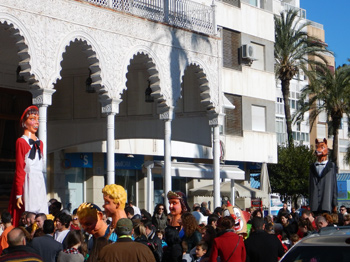 Just as we are about to call it a day, we stumble upon a parade of unique paper mache giants and big heads outside the Casino. Delighted adults and children of all ages follow along. Monday is a holiday, Dia de la Inmaculada Concepcion, beginning with an early morning parade and ending with a solemn evening procession with the statue of the Inmaculada Concepion. The procession stops at the Casino for a fireworks display before returning back to the church. A perfect ending to a fabulous weekend of festivities to start the Christmas season.
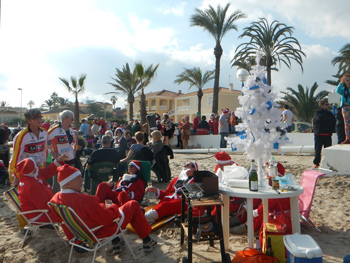
On Christmas Day everyone goes to the beach, including us. The beach is packed with families enjoying barbeques and picnics. Most of the men, women, children and even the dogs, are dressed in red and sporting holiday hats. We make our way through the crowd, past a group of Santas relaxing on beach chairs and enjoying a beer in the sun. Another Santa, with Mrs. Claus on his arm, strolls along the beach. A brass band entertains with familiar Christmas songs. Everyone smiles and shouts Merry Christmas or Felize Navidad! We are invited to share a table with some friendly folks. The lack of snow doesn´t make me feel any less Christmasy.
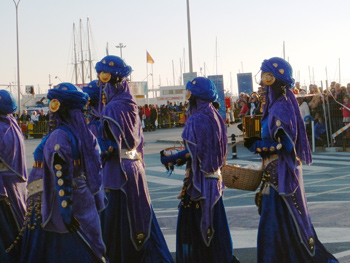 In Spain, the most important date in the Christmas season is not December 25. It is January 6, Epiphany, the day Three Kings from the east brought gifts to the infant Jesus. Fiesta de Los Tres Reyes Magos (Three Kings Day) starts on January 5 when the Three Wise Men arrive and parade through the streets handing out candies to all the children eagerly waiting. The parade ends at a church where the kings become part of a human nativity scene. That night the children put out their shoes and in the morning, if they have been good all year, they find them filled with gifts from the Magi. They leave out treats for the kings and water for the camels. Like children in North America do for Santa Claus and his reindeer.
We have the pleasure of experiencing this event. We wait patiently as The Kings; Gaspar, representing frankincense, Melchior, representing gold, and Balthazar, representing myrrh, arrive by boat in the coastal town of Torrevieja. They greet us in Spanish and English, waving as they pass by to join the parade.
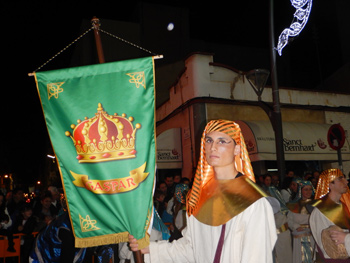 Along with their entourage, the kings participate in the traditional Epiphany parade that winds its way through the town. It is quite a spectacle with a variety of participants including Mary, Joseph, baby Jesus, Roman centurions, Egyptians, dancers, decorated riders, royal pages and a menagerie of animals. Excited children line the streets holding out bags for the many candies they receive from the participants in the parade, including the Three Kings. We enjoy the pageantry and spirit of the evening. Some of the children share their sweets with us.
There are parties and family dinners on January 6th. We attend a King´s Day party around the pool and are treated to traditional King´s Day cake called Roscón. A sweet, large donut-shaped bread covered in glazed cherries and sugar hides a plastic toy buried inside. The person who finds the toy is guaranteed good luck for the next year. We don´t find a toy but enjoy the cake and the company. Another wonderful Spanish tradition discovered!
The Spanish people know how to celebrate. Everything is centred on family, community and religion. It is the true meaning of Christmas.


If You Go:
The Costa Blanca is the 200 kilometres of coastline in the province of Alicante, Spain between Valencia and La Manga. Torrevieja is located 24 miles or 38.62 kilometres south of Alicante airport and 20 miles or 32 kilometres North of Murcia airport. It is a great place to visit during the Christmas season.
About the author:
Darlene Foster is a dedicated writer and traveller. She is the author of a series of books featuring Amanda, a spunky young girl who loves to travel to interesting places such as the United Arab Emirates, Spain
All photos are by Darlene Foster.
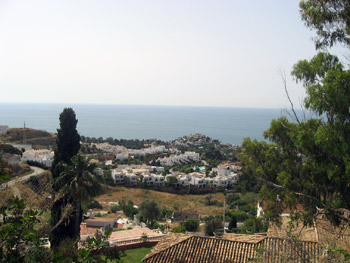 The whitewashed village, lined with narrow cobblestone streets overlooking the Mediterranean Sea, is the oldest of the three as it was founded by the Moors. I was fortunate enough to be in Benalmádena Pueblo in June for the major celebration of Corpus Christi where thousands of locals and tourists gather on the streets to watch the holy procession honouring the Body of Christ. On the eve of this festivity, hundreds of locals congregate to elaborately adorn the altars and decorate their balconies and windows in the brightest coloured tapestries. The community also collaborates in transforming the main street into a work of art by arranging 78,000 vibrant flower blooms in the form of a fabulously designed floral carpet. Meanwhile, the smaller streets are strewn and perfumed with palm leaves, rose petals, lavender, and aromatic herbs such as rosemary and thyme.
 Once the procession was over, I decided to indulge my curiosity by exploring what some have described as “the most beautiful place on earth.” I only knew that the Castillo Monumento Colomares was about a 15 minute walk from the center of the pueblo. However, no indication as to its whereabouts could be found anywhere along the remote area and I began to get discouraged in the blazing heat of the afternoon sun. Fortunately, after asking for directions several times, a cyclist appeared who knew how to get there.
 Nearly an hour had passed since I left the pueblo and I found myself gasping in delight when it finally appeared around the corner amidst isolated trees and bushes on a small curvy road.
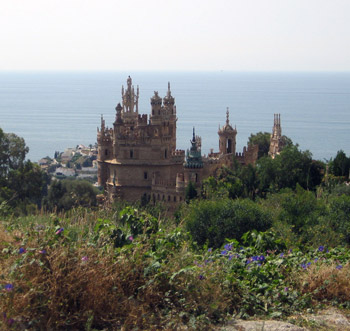 This enchanting structure was built during the late 20th century in memory of Columbus and the Discovery of America. The castle is actually the largest monument in the world dedicated to the Italian explorer. Seven years of work it took with the help of two bricklayers who incorporated several styles of architecture designed by a doctor. The castle, advertised as “a fantasy made by stone”, has 16 points of interest that include Isabella’s Castle, the Oriental Tower, and the Christmas Fortress of 1492. The complex also houses the smallest church in the world as listed in The Guinness Book of Records. The views of the Mediterranean Coast from this hidden gem adorned with decorative fountains, spiral staircases, and ornamental gates are magnificent, and I left wondering why the castle was not better promoted.
 A 20 minute walk from the Colomares Castle is the Mariposario de Benalmádena or “Butterfly Park.” Known as the largest one of its kind in Europe, this tropical garden paradise set inside a Thai temple is home to over 1500 exotic butterflies. More than 150 different species reside here among cascading waterfalls, floral gardens, and tropical plants.
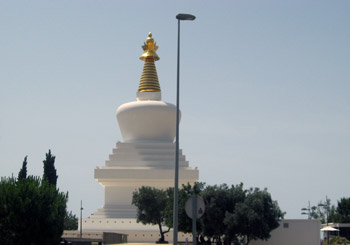 This urban residential town, nestled between the mountains and the sea, is home to several major family attractions and theme parks. Selwo Marina Delfinarium is the only one of its kind in the Andalusian region where you can feed penguins and swim with dolphins and sea lions. Tivoli World is a popular theme park known as the largest on the Costa del Sol. Across the entrance is the Teleférico or cable cars that take you to Mount Calamorro in 15 minutes where you can savour views of the coast and on clear days, Gibraltar and North Africa as well.
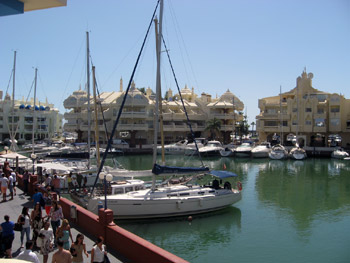 Paloma Park is a vast and serene gated area perfect for an afternoon stroll by the great lake on paved walkways adorned by plants, gardens, statues, and fountains. Peacocks, roosters, geese, ducks, pigeons, doves, and rabbits all call this park their home.
 By the entrance to the Marina stands the Moorish lookout tower, Torre Bermeja (Reddish Tower), the oldest of three that remain along the coast of Benalmádena. These cylindrical towers were raised to warn against the enemy ships approaching from North Africa. Although reconstructed during the 16th century, the tower first appears in documents dated to the 13th century. Of 16th century Christian origin are Torre Quebrada (Broken Tower) and Torre Muelle (Dock Tower) in the nearby, namesake suburbs of Torrequebrada and Torremuelle respectively.
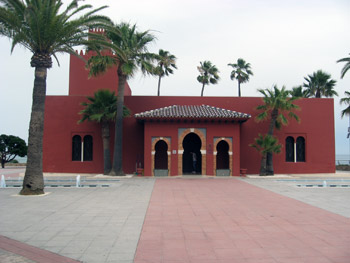
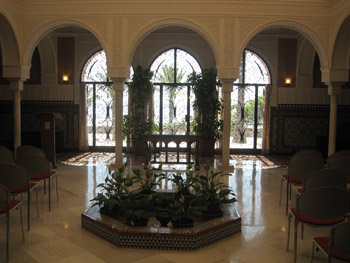 However, the main landmark of Benalmádena Costa is the stunning, burgundy palace known as the Castillo El Bil-Bil. The Moroccan-style structure was built on the seafront in 1930 for a wealthy Spanish-French family. Seven years later it was purchased by an American family who lived here for 30 years. When asking about the curious name, Salvador, the caretaker informed me that the names of the American family were Elsa (El) who was married to William (Bil) and both had a son together also named William (Bil.).
 Within the lovely gardens of El Bil-Bil is the monument to Ibn al-Baytar, an illustrious scholar born in Benalmádena during Moorish rule. The commemorative plaque reads in Spanish and English; Ibn al-Baytar – The distinguished botanist and pharmacologist born in Benalmádena: Benalmádena 1197 – Damascus 1248. Al-Baytar became one of the most renowned scientists of the Middle Ages. He is further immortalized and remembered as the most famous personality in the history of Benalmádena.

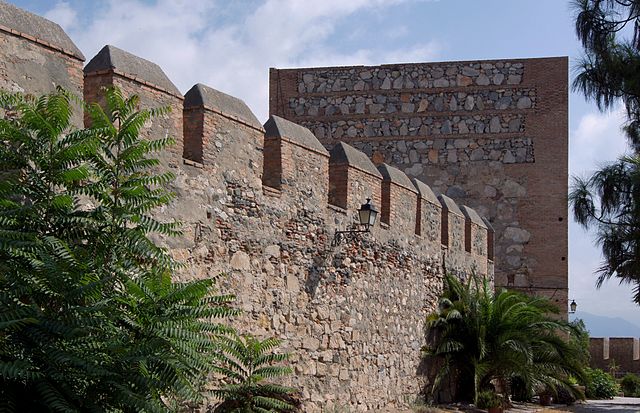 The coastal town of Salobrena is 10 km east of Almunecar. The coastline to Salobrena along the tropical coast is wild and rugged. To the left the awesome peaks of the Sierra Nevada and to the right the glistening blue of the Mediterranean. Salobrena stands unmolested by mass tourism, although now boasts an eighteen hole golf course. In the winter, the snow capped Sierra Nevada provides a magnificent backdrop to the green of the third hole.
 Further down the coast Almeria is home to yet another imposing castle. The drive from Salobrena takes about an hour and the terrain changes dramatically. Gone are the orange groves and fertile valleys to be replaced by a sea of plastic posing as green-houses – a scar on the landscape. From these eyesores the mountains become rocky, yielding neither crop nor greenery.
 The castle underwent changes under different Moslem governors, such as Almanazor and Havran the Slave, the fist independent ruler-lord of Almeria, who extended the walled area of the city towards the plain by three times the size of the original city of Almedina. The time of Banu Somahdis brought an era of splendour and was the setting for a cultured and literary court in the 11th Century. Later, in the 14th and 15th Centuries, under the Kings of Granada, it retained only its role as a coastal defence. It underwent two sieges, which demonstrated its effectiveness as a fortress; one in 1147, when it fell for the first time to the Christians of Alfonso VII, who was helped by the Genoese, the Catalans and the people of Pisa; and the other in 1309, which lasted a year, when James II of Aragon failed to take the castle.

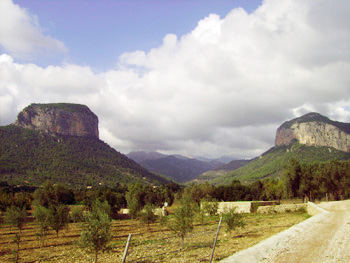
 Seeming to grow out of the craggy mountaintop, the castle has panoramic views of the Bay of Palma, the mountain range and much of the flat Mallorcan hinterland. Starting at the foot of the mountain the walk, which takes you past an agrotourismo hotel, takes around two hours. If you have faith in your driving reflexes and you have a hire car with a relatively good ground clearance you can continue to drive, shortening the walk to about forty-five minutes, and park amongst the goats at the smallholding adjacent to the Es Verger restaurant. Inside, the family are inevitably sat having one meal or another, while the wooden furniture, assorted mismatched objects around the walls (and the local matriarch) emit a faint smoky smell; a mixture of tobacco and the winter fires fuelled by the tonnes of wood piled up around the courtyard all year round. The jangling bells of the goats, which starts echoing down here and follows you all the way up to the castle, are enchanting and, were it not for the refrigerator of cola in the restaurant, you could be in a long-forgotten world of knights, serfs and Saracens.
 From this point, again, you can continue the drive but it’s not advisable. The few vehicles that do brave the stony track are usually taking supplies up to the hostel and ‘bar’ which is located within the 17th century church complex in the castle. Even these must stop at a final way-station where the last few hundred metres up the ancient steps are made with the help of donkeys, who you may see tethered in the shade along the flat ridge beneath the castle. Up here, in the still, warm air, with the craggy parapets looming down like an old eagle waiting to pounce from its precipitous eyrie, it’s easy to understand how this castle was a key defensive centre for both the pre-Islamic inhabitants of Mallorca and the subsequent Muslim and Christian rulers.
 The Balearic Islands came under the dominion of Islam perhaps as early as 707-8 AD but, as the Muslim world fragmented with civil wars, which saw the Abbasids emerge triumphant, the now independent Umayyad Emirate of al-Andalus, today’s Spain and Portugal, was forced to wage a series of wars in the Western Mediterranean to solidify its authority. It is from this period that we have the earliest historical mention of the Castell d’Alaro.
 The remaining walls around the castle are still an impressive sight and as you meander up the steps, cut out of the cliff to serve the pilgrims who would later trek to the church in the 17th century, you can feel the history coursing through the stones. Unlike many of the other castles in Mallorca there has been relatively little done to ‘restore’ the walls and what modern work there is tends to be associated with the church buildings which now house the hostel and bar.
 At the side of the mountaintop opposite to the gatehouse there is a completely sheer drop down to the farms in the valley below where birds swoop in out of their nests in the cliff’s crevices. Apart from them, and the deafening cicadas, it is completely still and you can almost imagine a scene from El Cid playing out on the plains far below. There are few views on the island to rival this and the ruin, unadulterated by heavy handed restorers, has maintained an allure that is unrivalled by the busier historical sites like Palma’s Almudaina and Capdepera. Just as the Banys Arabes offer a retreat from the clamour of modern Palma, Alaro transports you back in time to the age of chivalry, crusades and Andalusi enlightenment.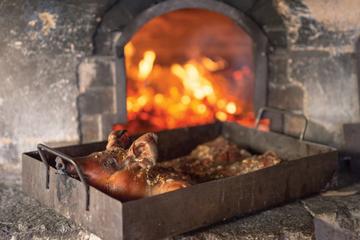
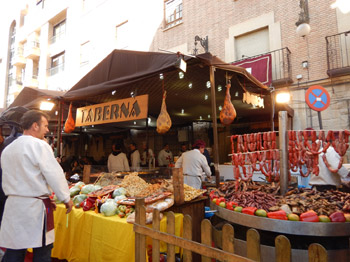
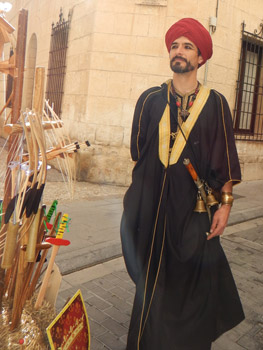 We wander aimlessly around the numerous stalls of artisans, bakers, butchers, fishmongers, drummers, acrobats, camels, ponies and much more scattered throughout the town. Every corner we round, we see new and exciting sites. A troupe of drummers march down a street and stop at the cathedral to put on a show. Knights Templar serve special cakes. Bread is baked on site in ancient wood-fired ovens. Belly dancers greet us on a side street. A camel tender gives rides to children while an ancient merry-go-round and a puppet show, including a dragon, delight the little ones. It is truly a family event with all ages taking in the festivities.

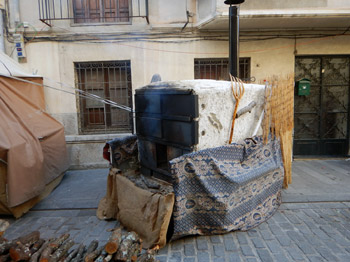 We stroll aimlessly around the various tents and stalls, tempted by the food for offer until we stop for a relaxing tea and delicious tapas. For dessert we share a bag of warm, freshly made churros sprinkled with sugar. Nibbling on our tasty treats, we wander some more, stopping to watch a sculpture at work and a blacksmith create a sword. Along one avenue is a display of birds of prey with an authentic falconer present. He allows a young boy to put on a glove and hold a falcon on his wrist. The smile never leaves this young man´s face. I particularly like the owls as each one seems to have a personality of its own.