Travel Thru History

Historical and cultural travel experiences

  • Home
  • Airfare Deals
  • Get Travel Insurance
  • Writers Guidelines

The Breathtaking Temples of Nara, Japan

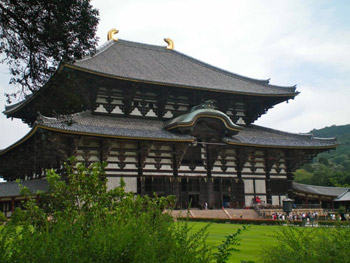
A flock of birds flying above the Great Buddha Hall.

If you’ve ever seen pictures of Nara online, you might think the beautiful temples couldn’t possibly be more breathtaking in person, but you’d be wrong. Out of all the cities in Japan I’ve visited, Nara remains at the top of my list. It’s a city full of historical treasures and landscapes that look like they came straight off postcards. If you’re visiting Kyoto or Osaka, you should seriously consider taking a day trip to see the breathtaking temples of Nara and everything else this ancient city has to offer.

A Brief History Of Nara, Japan

Before visiting Japan for the first time, I didn’t know much about Japan’s history. At the time, I just knew I loved the local food and was a big fan of anime. However, after visiting for the first time, I brought a book to read on a plane about Japan’s history. After reading it, I decided I had to come to Nara someday.

First and foremost, Nara is one of Japan’s major cultural and spiritual hubs, as seen by the city’s plethora of temples and shrines. In fact, the government’s concern that the city’s Buddhist temples were growing too dominant is one of the reasons they relocated the capital outside of Nara. What’s even more fascinating is that all of these temples survived over the years. They’ve withstood time, conflicts, and natural calamities, in contrast to many Japanese cities that earthquakes and fires have destroyed.

Visiting The Temples at Nara Park

The second time I visited Japan, I stayed in Osaka. From there, it’s only a short train ride away to Nara, Japan. I was surprised by how fast time flew before I stood in Nara Park. And then, it was just one surprise after the other. When I believed I had just witnessed the most spectacular architectural work, I would soon come across another one that was quite as stunning. Each temple and shrine is magnificent in its unique manner, and taken as a whole, they form an astounding collection of ancient Japanese architecture.

Kofuku-Ji Temple

In retrospect, the Kofuku-Ji Temple and the attached five-story pagoda, which are the first structures you encounter as you enter the park from the railway station, may have been the least striking. However, this in no way means Kofuku-Ji Temple wasn’t breathtaking in its own way. Standing in front of a building that’s more than a thousand years old felt indescribable. And that was only the start.

Kasuga Taisha Shrine

The second temple I visited that day was Kasuga Taisha Shrine. On my way there, I finally saw my first deer. I’ve read about the deers before and was ecstatic when one got near my group and me. However, the excitement from the deer quickly washed away as we got closer to the oldest shrine in Nara, Kasuga Taisha, and heard about its history. This was probably one of my favorite temples in Nara, Japan. I can’t explain it; it just blew me away.
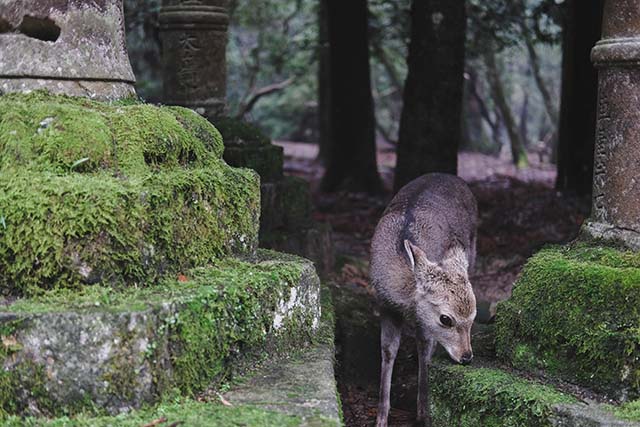
A deer in Nara park in Japan
Deer are quite common at Nara park.

Todai-ji Temple

Want to see the largest and most reverend Buddha statue in the world? In that case, you should visit Todai-ji Temple, or the Great Eastern Temple, as some call it. When it was built, the statue of Buddha inside it almost bankrupted Japan. Nigatsu-Do Hall is an absolute must-see, a stunning wooden structure with elaborately designed wooden carved panels and large white lanterns. The purification fountain with the dragon is among Nara’s most spectacular structures. You will hear your jaw drop as you pass through the majestic statues of the old Nandaimon Gate.

Yakushi-ji Temple

In my opinion, Yakushi-ji might just be my favorite of the breathtaking temples of Nara, Japan (I might’ve said that about every temple, though). The great vermillion hall of one of the Seven Great Temples of Nanto is almost beyond picture-perfect. Our tour guide told us the story of how the exquisite temple was repeatedly devastated by fire throughout history. Although today’s temple was rebuilt in the 70s, I couldn’t help but wonder if the original building was even more breathtaking.

If You Go:

Traveling to Nara is very easy thanks to Japan’s fantastic railway system. Japan Railways operates frequent quick trains between Osaka JR Station and Nara JR Station, where the journey usually lasts around forty-five minutes. Alternatively, you can take the Kintetsu Railway from Osaka-Namba Station to Nara Kintetsu Station, which is generally about thirty minutes but isn’t included in Japan Rail Pass.

Although I first visited Japan in the summer, I’ve heard that spring is the best time to visit Nara, especially when the cherry blossoms are in bloom. The city of Nara transforms into a sea of exquisite pink and white blossoms for a brief period, usually at the end of March or the beginning of April. However, sakura season usually brings in more tourists than any other season, so you can expect crowds and higher prices during that time. According to some, Japan is also lovely to visit in autumn and near the Christmas season, not the mention New Year’s Eve!

Moving To Japan

I can’t say I didn’t fall in love with Japan each time I visited. Over the years, I also met quite a few people who moved from the US to Japan, and I couldn’t be more jealous of them. Of course, moving to Japan isn’t entirely in my cards just yet, but maybe one day. If you’re considering moving to Japan, you should be ready for the change, culturally, but more importantly, a change in the climate. The seasons there aren’t like here at home. The first summer I visited, it almost didn’t stop raining for five days straight!

Final Thoughts

Nara is one of Japan’s most culturally significant cities, and Nara park is an absolute must-see if you’re visiting the Kyoto-Osaka area. When visiting, you’ll fall in love with the magical horizons and fascinating history of the place. If that’s not worth enough to you, consider how cool your pictures on Instagram will look if you take them in front of the breathtaking temples of Nara, Japan!

About the author:
Elsie Klein is a copywriter with a passion for traveling. Currently, she’s working All Season Movers, but when she’s not in the office, she’s booking her next trip in her venture to travel to visit every country in the world.

Nara Japan Deer Park Tour

Click Here To Browse Available Tours of Nara, Japan


Tagged With: Japan travel, Nara attractions Filed Under: Asia Travel

Rising Sun: Breakfasts in Japan

Japanese breakfast

by Lesley Hebert

Sampling local food when travelling can be quite an adventure. However, there have been occasions when I have not felt the need to be quite so daring. Trying to decide what to eat for breakfast when I was in the land of the rising sun with my husband and favourite travel companion was one of those times.

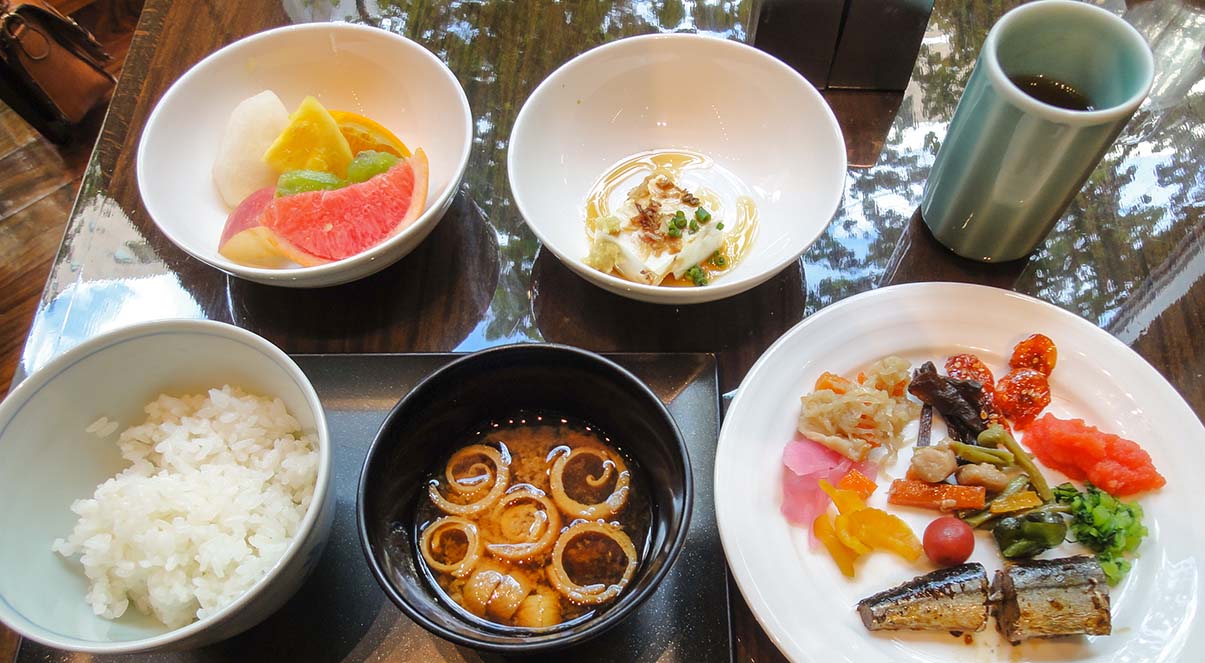
The hotel breakfast buffet was disappointing to say the least. Food choices that looked vaguely familiar included overcooked scrambled eggs, dried-out bread and some pinkish processed meat posing as ham. I was hardly surprised, therefore, to see many hotel guests ignore this rather suspect fare in favour of Japanese breakfast offerings. These included miso soup, plain steamed rice and salad. Although these seemed more suitable for lunch than breakfast, they appeared more appetizing than the garish pink meat at the other end of the buffet. But I grew distinctly queasy when I saw the locals tucking into seaweed and raw fish with obvious gusto.

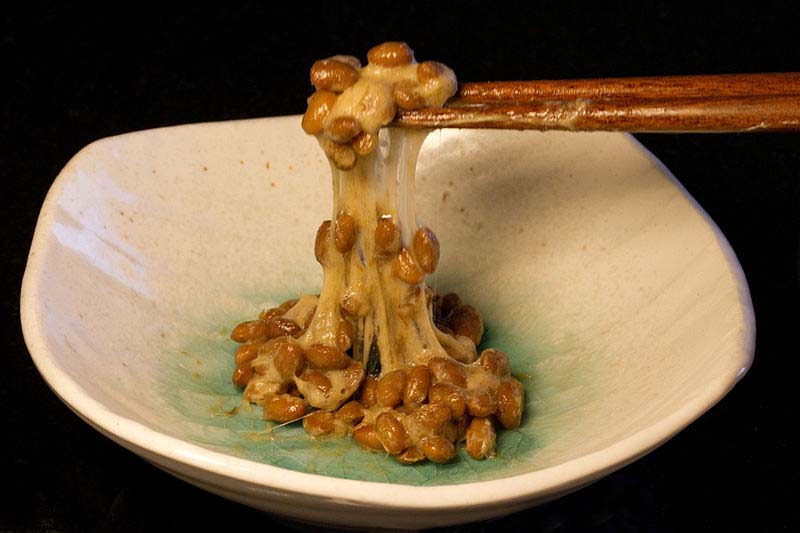
nattoWhat made me really queasy, however, was natto, a fermented soybean dish so uniquely Japanese that it deserves a whole paragraph to itself. Many Japanese love natto, and believe it provides amazing health benefits. But for me it gives a whole new meaning to the idea that if something is good for you it has to taste bad. When you help yourself to a serving of natto the first thing you notice is that the brown soybeans are covered with a pattern of yellowish slime which the Japanese lovingly compare to spider webs. As you stir the beans around, the slime seems to increase in volume. When you finally get the guts to pick a bean out of the dish, it draws a trail of slime up with it. It also has an aroma reminiscent of locker room sweat, and a taste to match.

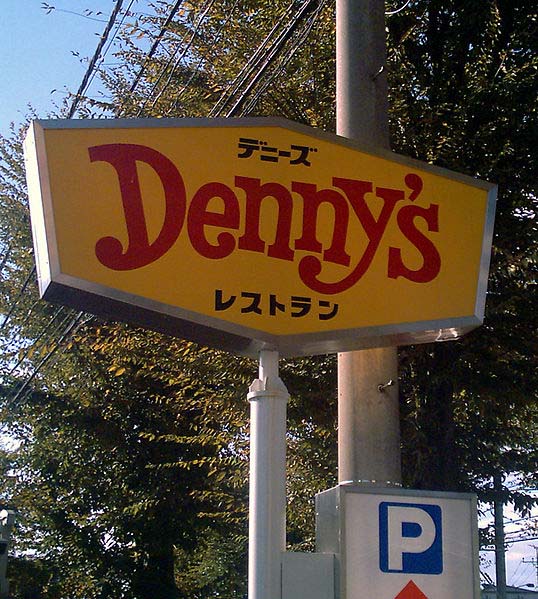
Denny's in JapanThe next morning we decided to explore more appetizing possibilities outside the hotel. We recognized many restaurant franchises, but did not relish a burger or fried chicken. We considered an egg Subway but my favourite travel companion fancied bacon and eggs, so Denny’s seemed like a good bet. It looked just like the Denny’s back home. It had the same red and yellow sign, the same inside decor, and the same fragrant coffee aroma.

Unfortunately, as we soon found out, this Denny’s did not offer bacon and eggs. The menu, of course, was totally incomprehensible. Because we could not read Japanese, we poured over pictures of various combinations of salad and fish, trying to decide what to order.

I had prepared for our trip to Japan by taking Japanese lessons and buying a dictionary. As we were studying the menu a polite little Japanese waitress came over to help us, and I haltingly managed to ask for coffee without having to look in my dictionary. She bowed courteously and poured our drinks while I basked proudly in my communicative success.

But pride, as they say, comes before a fall.

There was a container of sugar packets on the table. My FTC looked for some artificial sweetener, but there were none. Because he has a seriously misplaced faith in my magical ability to speak in tongues, he asked me if I could get the waitress to bring him some.

Not surprisingly, “Can you bring my husband some sugar substitute?” was not one of the useful phrases I had learned in Japanese class, so my first reaction was that he might just as well have asked me to scale Mount Everest. But, of course, I did have my dictionary. I knew the word for “sugar”, and I knew how to say “please”, so all I needed to do was find the Japanese for “substitute” and figure out how to cobble together a sentence.

I began attacking the problem like a challenging Sudoku puzzle and soon had my sentence ready. I called the nice little waitress over and made my carefully worded request.
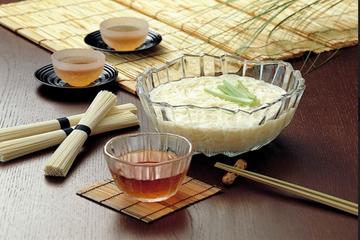
Her polite demeanour instantly changed. For a fleeting moment the friendly expression on her face was overcome by a look of stunned amazement. Her eyes seemed to bore into mine with a mixture of shock and disbelief. However, she made a rapid recovery, jolted back into friendly customer-service mode, and took the container of sugar packets into the kitchen. I sat smugly congratulating myself once again on my linguistic skill until she returned with an identical container to the previous one. I suddenly understood her reaction. I had somehow mistranslated “Please bring sugar substitute” into “Please change the sugar.”

“No, no, no!” I protested in broken Japanese. “Not that. Not sugar,” and started looking in the dictionary for “diabetes” and “blood.”

A very important aspect of Japanese culture seems to be “When in doubt, hold a meeting.” Consequently, the waitress enlisted the help of all the other waitstaff. They gathered in a huddle around us and held a rapid-fire discussion of the problem at hand until one of the waitresses had a Eureka moment. Her eyes grew to triple their normal size and her mouth fell open as she uttered “Aah! Diatsugaa!”

Who would have guessed that the Japanese for “sugar substitute” is actually “diet sugar” spoken with a Japanese accent?

“Yes! Yes!” I exclaimed triumphantly, “Diatsugaa!”

I was overjoyed. I had finally managed to communicate, and there were smiles all around. Life was wonderful, except for one small detail. They did not actually have any diet sugar.

Too embarrassed to go back to Denny’s, we bought fresh fruit, yogurt and baked goods at the local convenience store on our way back to the hotel at night so that we could enjoy a relaxing in-room breakfast the next morning.

And even though my experience at the Japanese Denny’s has ingrained the Japanese for sugar substitute so deeply in my mind that it will accompany me to the grave, I doubt if I will ever need to ask for “diatsugaa” again.

If You Go:

Japan offers several breakfast alternatives which are surprisingly easy on the budget. Japanese bakery coffee shops offer a wide assortment of freshly baked buns priced from 100 to 400 yen ($1-$4) which contain various sweet or savory fillings. Many train and bus stations have food counters or coffee shops which sell reasonably priced baked goods and freshly packaged sandwiches. You can buy hot tea and coffee from train station vending machines. Or you can do what we did and check out the convenience stores.


14-Day Classic Japan Tour: Nikko, Hakone, Takayama, Hiroshima, and Kyoto from Tokyo

Getting There and Getting Around

Tokyo has two international airports, Haneda and Narita. The best way to travel from Tokyo to other major cities is to use Japan’s excellent railway system. Trains are both clean and punctual. Also, the system is relatively easy to navigate as signage is posted in both Japanese script and the Roman alphabet. You can purchase a Japan Rail Pass from your local Japanese embassy or consulate before you go.

About the author:

Lesley Hebert is a graduate of Simon Fraser University. Now retired from teaching English as a second language in the classroom, she teaches ESL to international students via Skype. She also writes on-line articles which reflect a lively, inquiring mind and a love of travel, language, history and culture. Read more of Lesley’s articles at www.infobarrel.com/Users/HLesley

Photos by Lesley Hebert


Flavors of Japan Walking Tour in Tokyo

Tagged With: Japan travel, Japanese breakfasts, Japanese food Filed Under: Asia Travel

Japan: The Cormorants of Arashiyama

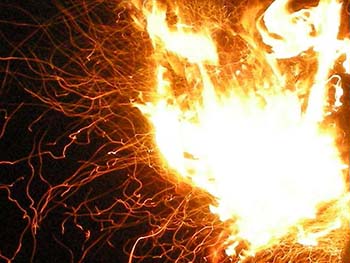
Balls of fire setting off across the bay by Anne Harrison

He led me to a bridge, carrying in his arms with him certain dive-droppers or water-fowls, bound to perches and about every one of their necks he tied a thread, lest they should eat the fish as fast as they took them. He loosened the dive-droppers from the pole, and within less than the space of one hour, caught as many fish as filled three baskets; which being full, my host untied the threads from about their necks, and entering the second time into the river they fed themselves with fish, and being satisfied, they returned and allowed themselves to be bound to their perches, as they were before.

So wrote the Franciscan monk Friar Oderic as he wandered barefoot across Asia in 1321. Apart from wearing shoes, little, it seems, has changed. A fat orange moon climbed into view as we crossed the Togersu-kyo, or Moon Bridge. Small balls of fire floated across the bay: the fishing had begun.

I first heard of cormorant fishing in infant school, sitting cross-legged on the floor and listening in wonder as our grey-haired teacher recounted her travels through exotic lands. Her tale of seeing the cormorants fish in Japan has stayed with me. It was a story belonging to an age long gone, to an enchanted time when magical things could happen.

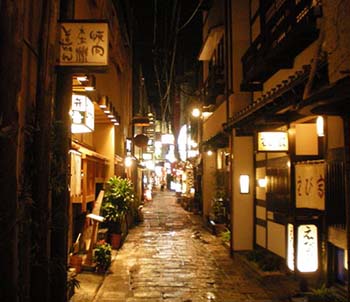
Balls of fire setting off across the bay Little more than a fishing village, Arashiyama is only twenty minutes from Kyoto. We were staying on the outskirts of the city, and as darkness fell we stood waiting in a pool of light on a deserted street, with only the sounds of crickets and frogs for company. As if straight from an anime an empty bus arrived, its lights bright against the night, and we wound through out-lying suburbs already closed for the night. Light from the occasional shop fell onto the street, and we passed tiny restaurants barely large enough to feed half a dozen locals. The driver announced each stop in a voice borrowed from Barry White.

(Never quite sure where I was going, somehow every bus I caught in Japan took me to the right place, as if the drivers knew better than I did where I was heading. On one, I met a group of young Austrians so busy watching their GPS to find the right stop, they barely glanced out the window.)

Arashiyama woodlandFinally, the bus stopped. Arashiyama seemed asleep. Against the darkness of the surrounding hills, lights twinkled from restaurants hiding on the other side of the bay. Coloured lights lit the narrow streets, and lanterns hung amongst the trees leading down to the water.

Marco Polo witnessed ukai (or cormorant fishing) in China, but it is first mentioned in a chronicle dating from the Sui Dynasty (A.D. 581-618): In Japan they suspend small rings from the necks of cormorants, and have them dive into the water to catch fish. In one day they can catch over a hundred.

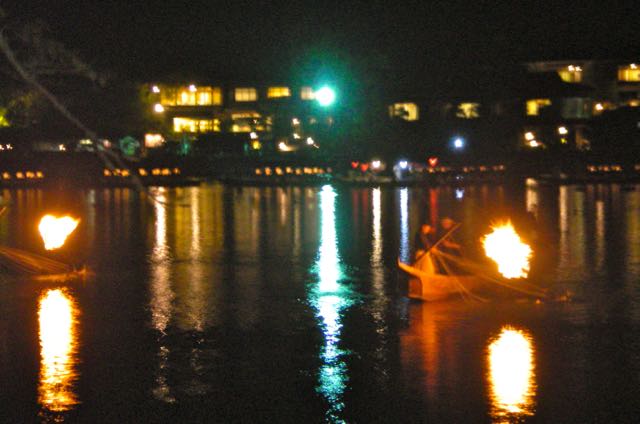
Fire from a brazier Barely visible in the darkness, small wooden boats floated across the water, much as they have done for the last thirteen hundred years. These ubune have flat bottoms so as to glide easily over the shallow bay. A metal brazier hangs over the front, and I could hear the sizzle and snap of the burning wood as sparks showered over the water. Most boats carry three fishermen; the usho, (or leader), who handles the cormorants as they dive for fish; the nakanori (or middle rider), who collects the fish from the birds, and the tomonori (or companion rider), who guides the boat. They still wear the traditional dark kimono, a straw skirt to repel water, and a linen cloth wrapped around their heads to protect them from sparks.

We crossed the Moon Bridge just as the cormorant boats set off across the bay. Still in a state of disbelief, I walked closer to the bay, expecting to pass some Omiyabito (or court nobles) sitting by the shore, as they did every summer in the Heian Era (794 to 1185 AD). Their arrival to watch the cormorant fishing marked the start of summer.

The ushoOnce darkness falls and the moon rises, the boats spend the evening passing back and forth across the bay. Some half-dozen tourist barges lay moored in the middle of the bay, much as the wealthier omiyabito had of old. The fishermen guided the ubune past them with great theatrical display, and the sounds of applause and cheers floated across the water. We found a spot away from the other tourists on a landing stage which ran into the bay. Watching the boats from here was akin to seeing a performance from behind the curtains of a grand stage; I could easily see the small metal ring around each cormorant’s neck.

restaurant entranceAttracted by the light from the brazier, fish swim close to the boat. With a splash the cormorants tumbled into the water. They can swallow small fish quite easily, but the ring prevents them swallowing anything larger – these they bring back to the boat, often given a smaller fish as a reward. A leash is attached to their collar, and with some dozen cormorants per boat, it takes remarkable skill on behalf of the usho to prevent these leashes from becoming a tangled mess. When enough fish had been collected, the birds rested on the sides of the boat, silhouetted against the light of the brazier as they stretched their wings to dry.

Matsuo Basho (1644-1694 AD) remains the most famous poet of the Edo Period, and today is revered in Japan for his haiku. On seeing the cormorant fishing he wrote:

Exciting to see
But soon after comes sadness
The cormorant boats.

If You Go:

International flights to Japan arrive in Kansai International Airport, near Osaka.

Both trains and buses run from either the airport or Osaka to Kyoto. From Tokyo, Kyoto is easily reached by train.

Travelling Around Japan

Hostels offer a cheaper alternative for accommodation in Japan; otherwise, why not try a typical ryokan?


Kyoto Temple, Shrine, Geiko & Sake Tour – $175.09

from: Viator

About the author:
Anne Harrison lives with her husband, two children and numerous pets in regional Australia. She discovered travel at the age of ten, then the world of history and philosophy. Her jobs include wife, mother, doctor, farmer, cheese-maker and local witch doctor, and her ambition is to be 80 and happy. Read more at anneharrison.com.au and hubpages.com/@anneharrison.

All photos copyright Anne Harrison:
Balls of fire setting off across the bay
The night streets of Kyoto
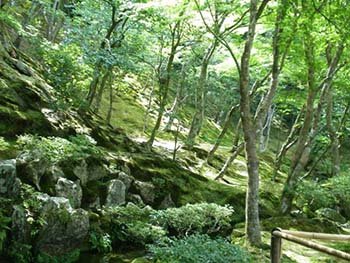
A quiet spot in Arashiyama
Fire from a brazier
The usho in his traditional kimono
Typical entrance to a restaurant

Tagged With: Arashiyama attractions, Japan travel Filed Under: Asia Travel

Christmas and New Year in Japan

Christmas in Japanby Leslie Hebert 

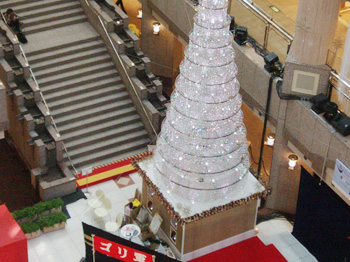
It was October when I visited Japan. Even though Christmas was still two months away I was surprised to discover that shopping malls and department stores were already getting into the commercial Christmas spirit. I was delighted by giant red and green Christmas tree shapes on the sides of office towers. I was awestruck by a glittering floor to ceiling tree of blue and gold lights in the atrium of a Tokyo shopping mall. I was charmed by sparkling lights displayed with a brilliant Japanese sense of aesthetics.

As a teacher of English as a second language, I have also learned from my Japanese students that Christmas in Japan is quite different from the western idea of Christmas. Rather than being a time for family, it is a time for couples and romance, while family celebrations are reserved for the much more traditional Japanese New Year.

Christmas

Even though Japan is not a Christian country, Christmas actually has a fairly long history there. Jesuit missionaries introduced the celebration of Christ’s birth to Japan in the sixteenth century but public celebrations ceased when Christianity was outlawed by the Tokugawa Shogunate in 1635. Christianity remained illegal until the Meiji restoration in the nineteenth century when the emperor opened Japan to the west and laid the foundations of modern Japan.

Although less than 1% of the Japanese population is Christian, and December 25 is not a public holiday, Japanese retailers have eagerly adopted the commercial aspects of the season.

Some cities hold Christmas markets to attract visitors. Many people attend Christmas parties while others deal with the accumulated stress of the previous year by getting drunk at December bonenkai, or “forget-the-year” parties. As Christmas Eve is considered a night for romance, many couples dine at expensive restaurants on December 24. Some Japanese put up Christmas trees in their homes and exchange gifts, and it is popular to eat “Christmas chicken” from Kentucky Fried Chicken. Christmas cake is also popular. However, rather than a traditional heavy western fruit cake, this is a light sponge cake decorated with cream and fresh strawberries.

New Year

While Christmas is considered a day for young people, drinking, and romance, New Year is a more sober family time.

This ancient celebration is steeped in traditions linked to both Shinto and Buddhism. People who have moved to large cities to work frequently travel home to be with their parents and other family members. Many houses display shimenawa, braided straw ropes which show that the home has been purified and is ready to welcome the kami, or Shinto god spirits. Kadomatsu, which are decorations made of pine and bamboo, may also be displayed to welcome the kami.

At midnight on December 31, Buddhist temples ring bells to welcome in the New Year. The bells are rung 108 times to remind people of the 108 human desires which they must renounced to attain a state of holiness. Many people stay up all night to welcome the new year and to pray to the rising sun. On New Year’s Day, most families visit Shinto shrines to pray for good health and happiness in the coming year.

A popular activity at the temple is the purchase of paper fortunes, known as o-mikuji, which provide detailed predictions concerning health, money and love prospects for the coming year.

Traditional food associated with New Year includes soba (buckwheat noodles). The long noodles are believed to represent long life, and are eaten on New Year’s Eve for good luck. It is, however, considered bad luck to eat soba after midnight.

Osechi ryori is a traditional family meal which is eaten on New Year’s Day. Since tradition dictates that nothing should be cooked on New Year’s Day, osechi consists of various pre-cooked, pickled and salted dishes that can keep without refrigeration. These are prepared ahead of time and packed in special meal boxes.

Each dish placed in the box has a special symbolic meaning. For example, black soy beans represent good health, herring roe represents fertility, and broad beans represent good fortune. Grilled fish promises a successful career, shrimp and dried persimmons are symbols of long life, and eating either taro or bitter orange expresses a wish for children.

One specific traditional New Year’s food which keeps for a long time without refrigeration is mochi or pounded sticky rice cakes.

I had a personal run-in with mochi while staying in the home of friends in Japan. My hosts served a stew containing some innocent-looking white cubes which I assumed were tofu. Of course, one of the cardinal rules of travel as well as other aspects of life is “never assume.” I picked up one of the cubes with my chopsticks, placed it in my mouth and chewed. Assuming that I had softened it sufficiently, I attempted to swallow it, only to find that it stuck in my throat. It cut off my breath and refused to move either down into my stomach or back up into my mouth. After a few seconds of panic, which at the time seemed as long as the entire 5,000 year history of the Japanese empire, I managed to bear down sufficiently with my throat muscles to force the offending cube down into my stomach before my face turned blue. As I did so, I seem to remember my hostess casually mentioning something about taking care with the mochi.

Because these little cakes are so chewy and glutinous, I was hardly surprised to learn that there are newspaper reports every New Year of people, particularly the elderly, choking to death while eating them. The Tokyo Fire Department even considers the danger serious enough to issue a warning about eating mochi alone.

On a happier note, New Year is a time to give beautifully decorated otoshidima or money envelopes to children, and to play traditional games such as badminton, spinning top and a card game known as karuta.

If You Go:

Getting There and Getting Around

Tokyo has two international airports, Haneda or Narita, and is served by many major international airlines.

The best way to travel from Tokyo to other major cities, such as Osaka, Kyoto or Yokohama, is to use Japan’s excellent railway system. Trains are both clean and punctual. Also, the system is relatively easy to navigate as signage is posted in both Japanese script and the Roman alphabet. I recommend that you purchase a Japan Rail Pass from your local Japanese embassy or consulate before you go.

References

♦ www.jnto.go.jp/eng/indepth/exotic/JapanesQue/1112/newyear.html
♦ en.rocketnews24.com/2013/01/03/%E3%80%90japanese-culture
♦ www.insidejapantours.com/japan-news/2665/mochi-choking-deaths
♦ www.jnto.go.jp/eng/indepth/history/experience/ab.html
♦ muza-chan.net/japan/index.php/blog/christmas-in-japan


Photo credit:
Tree of Light in a Yokohama Shopping Mall by Michael Hebert

About the author:
Lesley Hebert is a graduate of Simon Fraser University. Now retired from teaching English as a second language in the classroom, she teaches ESL to international students via Skype. She also writes on-line articles which reflect a lively, enquiring mind and a love of travel, language, history and culture.

Tagged With: Japan travel Filed Under: Asia Travel

Where The Deer Are Messengers Of The Gods

deer in Nara Japan

Nara, Japan

by Anne Harrison

I don’t know how old the lady was. She may have been fifty, but more likely she approached a century. Standing, she barely reached my shoulder. Her stall was filled with food for tourists to buy and feed the deer. Remarkably tame, over one thousand deer (or shika) stroll freely through Nara Park.

Founded in 710, Nara was Japan’s first permanent capital. (Until then, each new emperor established a new capitol.) Known as Heijo-kyo (or Citadel of Peace), Nara rapidly became one of Asia’s most splendid cities, despite being the capitol for only 74 years. It also became a major centre for Buddhism, for the mountain range here divides Heaven and Earth, creating a home the gods. For many, this area of Japan is sacred.

As are the deer, for they are the messengers of the gods.

Todai-ji templeOne of the delights of staying for a few nights in a place, rather than visiting for a day, is having the time for unexpected discoveries. We passed the night in a youth hostel, and breakfast came courtesy of the vending machine: a variety of different flavored minute noodles. Another machine offered a range of both hot and cold coffees, all served in a can, the temperature indicated by the color. The man on reception even made us some green tea in a gorgeous ceramic pot.

Our walk from the youth hostel led through a largely residential area. Old houses stood amongst immaculate gardens with perfectly manicured trees. Many had stone fences, and many had a statue of a beaver near the front door (for good fortune), often wearing a colorful apron or silly waistcoat. Being summer, gardens were awash with flowers.

We entered Nara Park through the little-used Tegamon Gate, which was literally hidden at the end of the street. It felt as if we had strolled into a local park; despite being the height of tourist season, the grounds seemed empty. Nara Park is some 1300 acres of parkland in the centre of the city; more than enough for hordes of tourists to lose themselves. Within its walls reside some of Nara’s most ancient and sacred buildings.

Within minutes, we’d spotted our first deer. Soon we saw them everywhere, some condescending to be patted, others scampering away should we venture too close. Meanwhile, paths and secluded walkways enticed us in all directions. There are more than enough temples to satisfy the most ardent visitors; tea houses to partake of refreshment, vending machines for cold drinks and ice-cream (flavors including green tea), and manicured lawns stretching down to lakes for simply relaxing. We even stumbled across some vegetable gardens and a few small rice paddies, all grown by the monks who live in the temple complexes. Walking down an alley of stone stairs, we came across a group of ladies painting.
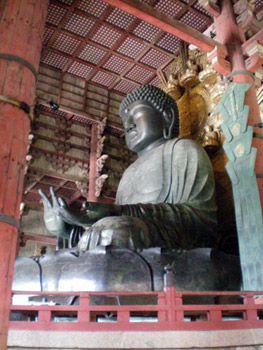
Buddha statueEverywhere we walked, the deer were relaxing in the shade, nibbling the grass, or simply wandering at leisure.

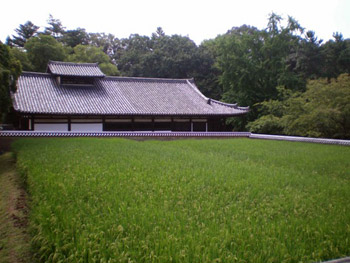
The Todai-ji temple complex comprises the Daibutsuden (or Buddha Hall), sub-temples, halls and pagodas. The great southern gate is 19m high, whereas the temple itself has a striking roofline of up-turned lintels with golden tips. Within the Daibutsuden is the Great Buddha; at 16m, it is reputedly the world’s largest bronze Buddha. Cast in 752 AD, its size is best appreciated when being cleaned, when it is not uncommon to see four or five monks standing in the Buddha’s outstretched hand.

A victim of earthquake, fires and wars, the Buddha’s head dates to 1692. In a wooden pillar behind the Buddha is a small hole; it is said anyone who can squeeze through it will reach Nirvana.

A grand flight of stairs leads from the Sarusawa Pond to the Kofuku-ji Temple and Treasure House. This temple complex was founded in 669, although many of the original 175 buildings no longer remain. The current temple, a five-story pagoda, has been destroyed by fire several times; this building dates to 1462. It is the second tallest pagoda in Japan. The Eastern Golden Hall (or Tokondo) was constructed in 726 by Emperor Shomu (who also constructed the Todai-ji Temple) to speed the recovery of the Emperess Gensho. Along with the Treasure House, it has several priceless images, including a 12th century wooden bodhisattva of wisdom. There are also Buddhist paintings, scrolls, calligraphy and sculptures, many dating from the Nara and Heian periods.

There are numerous temples within the park, but not to be missed is the Kasuga Grand Shrine. This is one of Japan’s most photographed Shinto shrines. Originally built in 710, it was demolished and an identical shrine rebuilt every 20 years, in accordance with Shinto strictures of purity and renewal. The current building is relatively modern, dating to 1863.

rice paddyThe walkways around the shrine are lined with some 3000 stone and bronze lanterns. These have been donated over the centuries as tokens of thankfulness and faith. During festivals in February and mid August they are lit: a spectacular time to visit. You can also buy a slip of paper (omikuji) with your fortune; if unfavorable, simply tie it to one of the trees to negate its effects. Behind the temple is the Rokuen, a botanical garden preserving Japanese plants, and famous for its wisteria, plus its Homotsuden, a hall displaying costumes, swords and ancient armor.
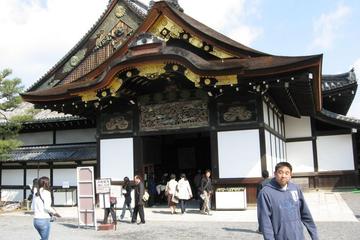
Visiting Nara Park is walking back into the Japan that once was. As we left the park, the deer were using the subway to cross under the main street. From the roof of a nearby building we looked back over the park itself, with its primeval forest in which the trees have not been felled for hundreds of years. I felt I was not only looking back into time; I gazed over a sea of tranquility so often lost in this modern age.

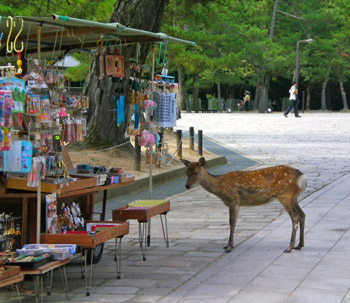
And there are the deer. We finally succumbed to their doe-eyes, and bought a bag of wafer-biscuits. Suddenly they were no longer shy. They instantly surrounded us, demanding their share, and more than ready to head-butt us in the back should we hold out on them. One had the temerity to approach the food stall; immediately the tiny old lady whipped out a broom and chased it away. The deer may be sacred, but they don’t get a free feed.


Nara Afternoon Tour of Todaiji Temple, Deer Park and Kasuga Shrine from Kyoto

If You Go:

♦ Reaching Nara: From Kyoto Station, either the JR Nara Line or the Kintetsu Limited Express (both under an hour)
♦ From Osaka Namba Station: Kintetsu Nara line, approx. 45 min
♦ Tourist Information: Offices are at both major train stations in Nara
♦ Japan Tourism
♦ Nara Youth Hostel
♦ Japan Hotels and Ryokan

About the author:
Anne Harrison lives with her husband, two children and numerous pets on the Central Coast, NSW Australia. Her jobs include wife, mother, doctor, farmer and local witch doctor – covering anything from delivering alpacas to treating kids who have fallen head first into the washing machine. Her fiction has been published in Australian literary magazines, and has been placed in regional literary competitions. Her non-fiction has been published in medical and travel journals. Her ambition is to be 80 and happy. Her writings are available at anneharrison.com.au and anneharrison.hubpages.com

All photos are by Anne Harrison:
A deer investigating a food stall
The Todai-ji temple
The size of the Buddha is hard to appreciate
A rice paddy in the temple grounds


Tagged With: Japan travel, Nara attractions Filed Under: Asia Travel

  • 1
  • 2
  • 3
  • Next Page »

MORE TRAVEL STORIES:

The Wonders of Kuala Lumpur, Malaysia

Why Penang, Malaysia is Heaven for Foodies

Celebrating Chinese New Year

Salta, Argentina

Liverpool Black History Walking Tour (part 1)

Vienna: City of Music, Culture and Romance

The Many Faces of Macau

Best Things to Do in Milan When Visiting for the First Time


SEARCH

DESTINATIONS

  • Africa Travel
  • Antarctica travel
  • Asia Travel
  • Australia travel
  • Caribbean Travel
  • Central America Travel
  • Europe Travel
  • Middle East Travel
  • North America Travel
  • Oceania Travel
  • South America Travel
  • Travel History
  • Travel News
  • UK Travel
  • Uncategorized
  • World Travel
facebook
Best Travel Blogs - OnToplist.com

Copyright © 2025 Cedar Cottage Marketing | About Us | Contact | Privacy Policy | Terms & Conditions | Copyright Notice | Log in